

There’s a pattern the enemy loves to exploit. It’s subtle at first—a whisper, a nagging thought, an old memory resurrected at just the wrong moment. You’re not enough. You’re a fraud. Look at what you’ve done. Who do you think you are?
These aren’t random intrusions. They’re targeted. And they all aim at the same vulnerable place: your sense of who you are.
The enemy of our souls is not particularly creative, but he is devastatingly effective. His oldest strategy, the one he used in the garden and the one he tried on Jesus in the wilderness, is the same one he uses on you today: make them question their identity.
“If you are the Son of God…” he said to Jesus in Matthew 4.
Notice he didn’t start with a command. He started with an if. A seed of doubt about who Jesus was. Because the enemy knows that if he can shake your understanding of who you are, everything else becomes negotiable.
The Battlefield Is Your Mind
Personal attacks from the enemy rarely look like what we imagine. They’re not always dramatic or obvious. More often, they sound like your own voice—critical, shaming, accusing. They come dressed as “just being realistic” or “facing hard truths.” But their fruit gives them away: condemnation, hopelessness, isolation, and paralysis.
Conviction from the Holy Spirit draws you toward God. Accusation from the enemy drives you away from Him. One offers a path forward. The other offers only a pit.
And the enemy’s accusations almost always target your identity. He wants you to believe you are defined by your worst moments, your deepest failures, your most shameful secrets. He wants you to forget what God says about you.
What God Says About You
This is where the weapon is forged.
When you place your faith in Christ, something profound happens—not just positionally, but ontologically. You become something new. Paul doesn’t mince words in 2 Corinthians 5:17: “If anyone is in Christ, he is a new creation. The old has passed away; behold, the new has come.”
You are not a sinner trying hard to be good. You are a saint who sometimes sins. That distinction matters more than you might realize.
Scripture is relentless in describing who believers are in Christ. You are chosen, adopted, redeemed, forgiven, sealed, and seated with Christ in heavenly places. You are a child of God, a co-heir with Christ, a temple of the Holy Spirit. You are His workmanship, created for good works. You are loved with an everlasting love that nothing—nothing—can separate you from.
These aren’t motivational affirmations. They are declarations of reality. And when the enemy comes with his accusations, this is the ground you stand on.
Why Identity Is the Strongest Weapon
Here’s the thing about identity: it determines response.
If you believe you’re worthless, you’ll accept treatment that confirms it. If you believe you’re alone, you’ll isolate yourself further. If you believe you’re beyond redemption, you won’t bother fighting for holiness.
But if you know who you are—really know it, deep in your bones—the enemy’s lies lose their power. When he whispers “you’re a failure,” you can respond with truth: “I am more than a conqueror through Him who loved me.” When he says “God is disappointed in you,” you can counter with reality: “There is now no condemnation for those who are in Christ Jesus.”
This is exactly what Jesus modeled in the wilderness. Every temptation was met not with argument, not with self-defense, but with “It is written.” Jesus knew who He was. The enemy’s “if” couldn’t touch that certainty.
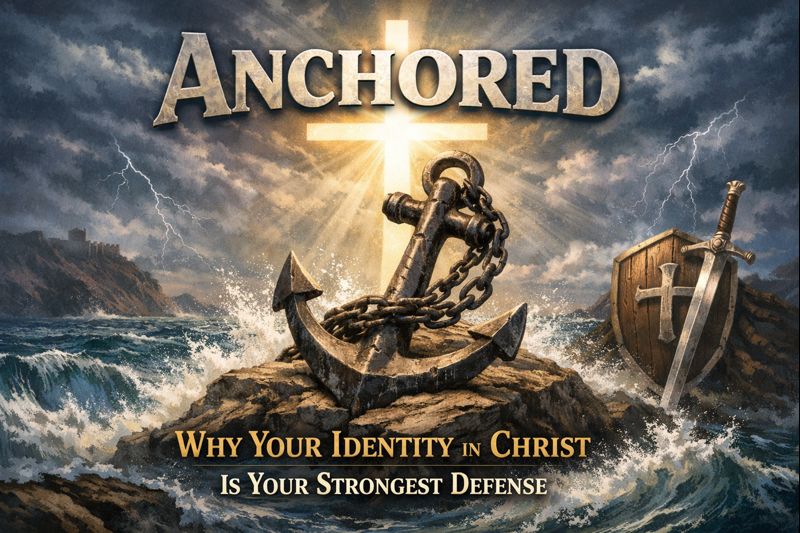
Your identity in Christ is the foundation that makes every other piece of spiritual armor effective. The shield of faith, the sword of the Spirit, the breastplate of righteousness—they all depend on you knowing whose you are and who you’ve become in Him.
Cultivating Unshakeable Identity
Knowing these truths intellectually isn’t enough. The enemy attacks when you’re tired, grieving, lonely, or discouraged—precisely when head knowledge feels distant and abstract. The goal is to move truth from your head to your heart, to make it the reflexive response of your soul.
This happens through saturation. Read Scripture not just for information, but for formation. Meditate on passages that declare who you are in Christ until they become more familiar than the lies. Speak them aloud. Write them down. Let them be the first thing you reach for when darkness presses in.
It also happens through community. The enemy loves isolation because it’s easier to lie to someone who has no one speaking truth into their life. Surround yourself with people who will remind you who you are when you forget.
And it happens through practice. Every time you reject a lie and replace it with truth, you’re training yourself. You’re building a reflex. You’re learning to fight.
The Victory Is Already Won
Here’s the good news that changes everything: you’re not fighting for victory. You’re fighting from it.
The enemy has already been defeated. His power was broken at the cross. The accusations he brings have already been answered by the blood of Christ. When he points to your sin, you can point to your Savior.
“Who shall bring any charge against God’s elect?” Paul asks in Romans 8. “It is God who justifies. Who is to condemn? Christ Jesus is the one who died—more than that, who was raised—who is at the right hand of God, who indeed is interceding for us.”
The enemy has no legal standing. He’s a defeated accuser hurling accusations that have already been dismissed in the highest court. When you know who you are in Christ, you stop cowering before a foe who has no real power over you.
Stand firm, then. Not in your own strength or righteousness, but in the unshakeable reality of who God says you are. That identity—beloved, redeemed, made new—is the weapon no enemy can overcome.
You are not what you’ve done. You are not what was done to you. You are who God says you are. And He says you are His.



0 Comments